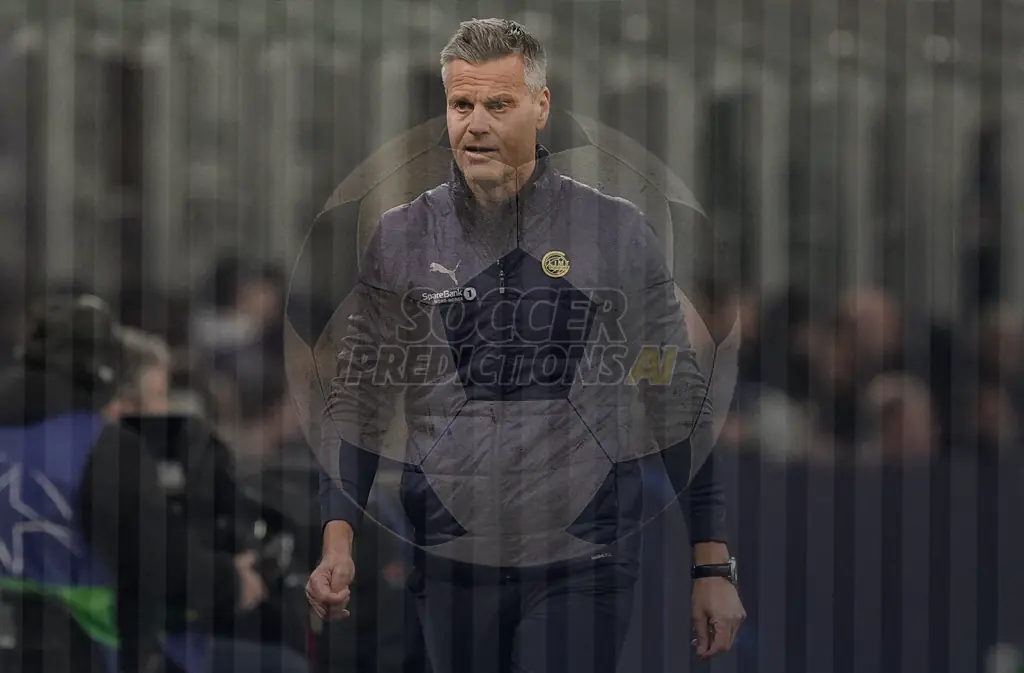
Bodø/Glimt’s fairytale Champions League run continues after home and away wins over Inter, with coach Kjetil Knutsen, a former teacher inspired by Jürgen Klopp’s high intensity style, earning acclaim for his relentless work ethic and “rock and roll” 4-3-3.
Bodø/Glimt added another golden chapter on Tuesday to the remarkable run they have been putting together in this Champions League, knocking out Inter Milan with victories both at home and away after already beating Manchester City and Atlético Madrid in the league phase.
For a club from a small city north of the Arctic Circle, it is the kind of sequence that still sounds unreal when written down, because it places them in direct comparison with institutions that operate on different budgets, different markets and different expectations. Yet Bodø/Glimt have turned it into a repeatable idea rather than a one off fairy tale, and much of the credit continues to fall on the figure on the touchline, Kjetil Knutsen, a former secondary school teacher who has pushed Norwegian football onto Europe’s biggest stage by committing fully to an aggressive, high tempo identity rooted in what he openly describes as a “strong, intense idea of football”. Knutsen does not hide the reference point. He calls it inspiration from Jürgen Klopp’s Liverpool, the type of football that attacks in waves, presses relentlessly and turns transitions into weapons, a style often labelled “rock and roll” because of its volume, speed and refusal to slow down.
The background that makes Knutsen’s rise so unusual is that he did not arrive with the traditional pedigree of an elite coach. He did not build a reputation as a top level player and he did not transition straight into the professional game. For 15 years he lived a double life in football terms, coaching in modest environments while continuing to work as a teacher, often part time, shaping his methods away from the spotlight. What remained constant throughout that period was his loyalty to a clear model. His teams were built around a dynamic 4 3 3, designed to be proactive rather than reactive, with speed and fluidity in transitions, constant pressing without the ball, and an intensity that is supposed to be visible in every phase of the game rather than only in highlight moments. In practice, that means a team that tries to win the ball back quickly, pushes numbers forward, and treats the spaces between midfield and attack as a place to accelerate rather than to pause.
When Knutsen stepped into full time professional football in 2017, it was not simply a career move. It was a personal reshaping of his life. He left his family in Bergen and moved alone to Bodø, a decision that underlines how seriously he took the opportunity and how much of himself he was ready to invest in the project. The routines that followed have become part of the club’s folklore because they reflect an image of obsession and simplicity. The CEO, Frode Thomassen, described to ESPN a daily life measured in a few hundred metres. Knutsen lives roughly 100 metres from the stadium, does not own a car, and walks in every day. Even the supermarket where he shops is around 100 metres the other way. Thomassen’s description of him as a “workaholic” is not presented as a cliché but as a literal schedule. Knutsen goes from home to the stadium, from the stadium to the supermarket, and back home, and the CEO says the coach is there when he arrives in the morning and still there when he leaves, a routine that paints him as someone who treats football not as a job with set hours but as an environment he inhabits.
That obsessive consistency also explains how he arrived in Bodø/Glimt with a clear set of ideas already formed. Before taking on this project, Knutsen had built success in lower league settings, winning two promotions with the modest Hovding and another promotion from the third to the second division with Åsane. Those achievements matter in this story because they show a coach comfortable with development, repetition and building structure, the kind of skills that become essential when a club is trying to grow rather than merely maintain its place. In his first season at Bodø/Glimt he was part of a promotion to the Norwegian top flight as assistant to Aasmund Bjørkan, then became head coach when Bjørkan changed roles and moved into the sporting director position. That handover was important because it created continuity. It allowed the club to keep a coherent direction rather than constantly resetting.
The results since then have turned Knutsen from a promising coach into a figure with real historical significance in Norway. He delivered four league titles, and the first of those, in 2020, was also the first league championship in Bodø/Glimt’s history, a milestone that fixed him permanently in the club’s identity. Domestic dominance, however, was only the beginning of how the club’s reputation spread. In Europe, Bodø/Glimt have consistently produced runs that would be notable even for clubs with far greater resources. They reached the quarter finals of the Conference League in 2021/22, and last season they reached the semi finals of the Europa League, becoming the first Norwegian team to go that far in any European competition. Even within that Europa League run, they registered statement wins in the league phase against FC Porto and Braga, results that helped turn European nights in Bodø into events that opponents no longer treat as comfortable trips.
Against that backdrop, this Champions League campaign feels like an escalation rather than an accident. Beating Manchester City and Atlético Madrid in the league phase was already enough to challenge assumptions about what a Norwegian club can realistically do at this level, and following it by eliminating Inter Milan over two legs with wins home and away pushes the story into a different category. It is no longer only about one special night or one tactical surprise. It suggests a team with an identity so clear and so well drilled that it can travel, adapt without abandoning its principles, and still impose itself. This is where the Klopp influence becomes more than a quote. It becomes a structural point. High intensity football can collapse if it is not supported by fitness, automatisms and belief. When it succeeds, it makes opponents uncomfortable because it compresses time. It forces defenders and midfielders to act under pressure, shortens passing options, and creates the kind of chaotic second balls that can turn into immediate attacks.
What makes the Bodø/Glimt story particularly compelling is that the coach at the centre of it is not presented as a glamorous figure. Knutsen’s image is almost the opposite. He is described as someone who walks to work, shops locally, and spends virtually all his time inside the club. That simplicity amplifies the contrast with the scale of the opponents he has beaten. It also strengthens the narrative that this success comes from method rather than money. A coach who built his approach over years in lower divisions and in part time work, then moved away from home to dedicate himself entirely to a project in a remote football outpost, is not the traditional profile of a Champions League headline. Yet the results have put him there.
With victories over elite opponents piling up, attention inevitably shifts beyond Norway. Coaches who produce this kind of European run become targets for bigger leagues, and clubs across Europe watch not only the results but the mechanisms behind them, trying to understand whether the methods can be transplanted. For Bodø/Glimt, the challenge becomes sustaining the model as expectations rise, as opponents study them more closely, and as the club’s own success creates pressure to keep evolving. For Knutsen, the challenge is to remain faithful to the principles that got him here while continuing to refine the details that decide matches at this level. If this campaign has shown anything, it is that his “strong, intense idea” is not only a slogan. It has become a competitive advantage, strong enough to turn a club from northern Norway into one of the Champions League’s most disruptive stories.