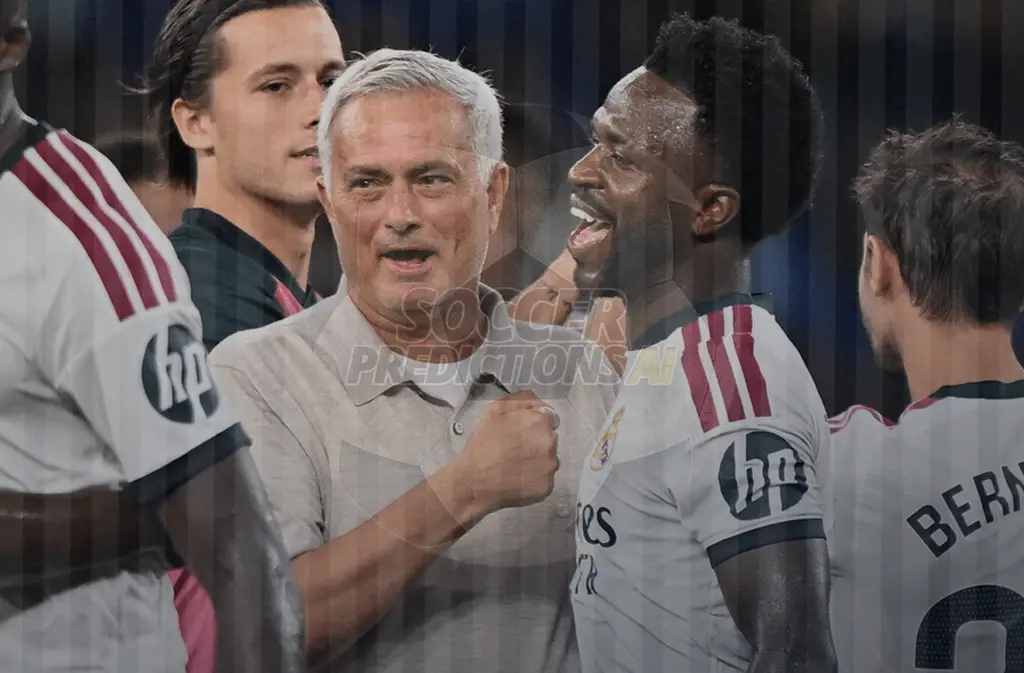
Vinicius Junior scores five goals for Brazil and returns to Real Madrid, leaving Mourinho with a selection dilemma involving Diomande and Arda Guler.
Vinicius Junior Gives Mourinho a Major Selection Dilemma After Five Goals for Brazil
Vinicius Junior is returning to Real Madrid with renewed confidence, five goals from two international appearances and a determination to reclaim his place in José Mourinho's starting lineup. The Brazilian winger, who has endured a difficult opening to the season and recently completed a four-match suspension in La Liga, produced two outstanding performances for his country during the November international break. His return to form comes at a particularly interesting moment for Real Madrid, with the team enjoying its best run of results under Mourinho and several attacking players having established themselves during his absence.
Madrid resume their domestic campaign on Saturday, November 21, when Celta Vigo visit the Santiago Bernabéu. The atmosphere surrounding the club is considerably more positive than it was earlier in the season, following eight consecutive victories across La Liga and the Champions League. Mourinho's team won all eight matches between the two international breaks, including a convincing 3-0 victory away to Valencia immediately before the November fixtures. That successful run has strengthened the manager's position and created a sense that Madrid are finally finding the balance that was missing during the opening weeks of the campaign.
However, the return of Vinicius presents Mourinho with an unexpected problem. During the Brazilian's suspension, summer signing Yan Diomande established himself as a regular starter on the left wing, providing the pace, directness and attacking intensity that had been missing from Madrid's performances in that area. Arda Güler has also become increasingly important on the opposite flank, while Jude Bellingham and Kylian Mbappé remain central figures in the team's attacking plans. With so many players competing for limited positions, Mourinho must now decide whether to restore Vinicius immediately or preserve the combination that has produced such impressive results.
The dilemma is made more complicated by the circumstances surrounding Vinicius himself. His performances for Brazil suggest that he has rediscovered some of the explosiveness and confidence that made him one of the world's most dangerous attacking players, but Mourinho will also be aware that the demands of international friendlies differ considerably from those of a competitive La Liga encounter. The manager therefore faces a decision that involves not only individual quality but also tactical balance, defensive responsibility and the relationships that have developed between his players over recent weeks.
Five Goals in Two Matches Transform Vinicius' International Break
For Vinicius, the November international break could hardly have arrived at a more important moment. The Brazilian had been struggling to reproduce his best performances for Real Madrid, with his lack of goals and assists attracting increasing criticism in Spain. His four-match domestic suspension had also prevented him from responding on the pitch, leaving him watching as Mourinho's team continued winning without him. International duty offered the opportunity to escape that difficult environment temporarily, work with a different coaching staff and rediscover the attacking confidence that had appeared to desert him.
His response was immediate. In Brazil's friendly against Japan on November 14, Vinicius scored twice with impressive finishes, providing a reminder of his ability to create goals through individual quality. Although Brazil ultimately suffered a 3-2 defeat, the winger was one of the standout performers and demonstrated a level of determination that had not always been evident during the opening months of the club season. His movement was sharper, his decision-making appeared more instinctive and he repeatedly attempted to influence the game rather than allowing opponents to dictate his involvement.
Three days later, Vinicius delivered an even more spectacular performance against Singapore. The Real Madrid forward scored a first-half hat-trick as Brazil recorded a commanding 7-0 victory, completing his three goals within the opening 21 minutes. His acceleration, positioning and willingness to attack the penalty area caused constant problems for the opposition, while his finishing demonstrated the confidence of a player determined to make every opportunity count. By the time he was substituted after an hour, the result was already beyond doubt and he had completed his first hat-trick for the Brazilian senior national team.
Interestingly, Vinicius appeared disappointed when he was replaced despite having already scored three times. Brazil's coaching staff had decided to manage his playing time rather than expose him to unnecessary physical risks with the match effectively settled, but the winger seemed eager to remain on the pitch and continue scoring. That reaction offered another indication of his desire to make the most of the international break, particularly after a period in which his performances and commitment had been questioned. He finished the two matches with five goals from approximately 150 minutes of football, an extraordinary return that will inevitably strengthen his argument for immediate inclusion against Celta.
There is, however, an important distinction between enjoying an exceptional week with the national team and demonstrating that every difficulty has been resolved. Japan provided a competitive challenge and eventually won their encounter, while Singapore offered considerably less defensive resistance. Mourinho will undoubtedly welcome the goals and the renewed confidence, but the manager must still evaluate how Vinicius fits into the structure that has helped Madrid achieve eight consecutive victories. The Brazilian has reminded everyone of his individual quality; the next challenge is to translate that form into a team that has changed significantly during his absence.
Vinicius Admits Difficult Summer Affected His Real Madrid Performances
Before Brazil's friendly against Singapore, Vinicius spoke candidly about the difficulties he had experienced following the 2026 World Cup. The forward acknowledged that his summer preparation had not been as thorough as in previous years and suggested that the emotional consequences of Brazil's early elimination had influenced his approach to the new season. The national team's defeat against Norway in the round of 16 was particularly disappointing for a country that had entered the tournament with expectations of competing for the trophy. Vinicius admitted that the experience affected him personally and contributed to a period in which he did not maintain his usual training routine.
Rather than immediately concentrating on preparing for the new campaign, the Brazilian wanted to recover from the disappointment and spend time away from football. He subsequently recognised that the reduction in his physical preparation may have contributed to his difficulties during the opening weeks of the season. For a player whose game depends heavily on acceleration, repeated sprints and the ability to beat defenders in individual situations, even relatively small differences in physical condition can affect performance. Vinicius did not attempt to present those circumstances as an excuse, instead acknowledging that he could have prepared more effectively.
His summer was also complicated by uncertainty surrounding his future at Real Madrid. Several clubs expressed interest in signing him, with reports suggesting that some proposals involved enormous financial figures. However, both the player and the Spanish club remained determined to continue their relationship, eventually reaching an agreement over a contract extension that reinforced his position as one of the central figures in Madrid's long-term sporting project. Although the outcome was positive, Vinicius admitted that the attention surrounding the negotiations had placed additional pressure on him.
That pressure did not disappear once the agreement was completed. A major contract renewal inevitably creates expectations, particularly when it involves a player already considered among the most recognisable figures at Real Madrid. Supporters expect decisive performances, while opponents and the media scrutinise every missed opportunity or disappointing result. Vinicius has become accustomed to dealing with intense attention throughout his career, but the combination of World Cup disappointment, reduced physical preparation and contractual uncertainty created a particularly challenging environment.
His private life also became the subject of considerable media attention, with stories extending beyond football and into entertainment coverage. The Brazilian has regularly attracted interest because of his public profile, but the increased discussion surrounding his personal activities added another distraction during a period when his performances were already being questioned. Rather than addressing every rumour, Vinicius used his international appearances to demonstrate that his footballing ability remained intact. The five goals against Japan and Singapore offered a much more effective response than any public explanation, allowing him to return to Madrid with a renewed sense of confidence.
Yan Diomande Has Made Vinicius' Return More Complicated
Perhaps the most significant development during Vinicius' suspension has been the emergence of Yan Diomande as one of Real Madrid's most influential attacking players. The 19-year-old Ivory Coast international arrived during the summer with considerable expectations, but Mourinho initially introduced him gradually, recognising that adapting to the demands of playing for Madrid would require time. His opportunities increased as the season progressed, and the absence of Vinicius eventually provided the opportunity to establish himself in his preferred position on the left wing.
Diomande responded with performances that have made him extremely difficult to leave out of the starting lineup. His direct attacking style has given Madrid an important outlet during transitions, while his willingness to challenge defenders has helped create opportunities for Mbappé and the midfielders arriving in advanced positions. Unlike players who consistently move towards central areas, Diomande is comfortable maintaining width and attacking the space outside opposing full-backs. That quality stretches defensive lines and creates additional room for teammates, making him a valuable component of Mourinho's attacking structure.
The Ivorian has also contributed through his work without possession, an aspect of his game that Mourinho particularly values. His speed allows him to recover defensive positions when necessary, while his willingness to press opponents helps Madrid maintain intensity during transitions. Those characteristics have contributed to the improved balance seen in recent matches, particularly when the team have faced opponents capable of attacking quickly after recovering possession. Diomande's influence cannot therefore be measured exclusively through goals and assists, even though his attacking contributions have also been impressive.
His success has created an unusual situation for Vinicius. The Brazilian was previously considered the automatic first choice on the left wing, a position in which he developed into one of the most dangerous attacking players in European football. However, Diomande has performed so well that removing him now could disrupt a team enjoying an exceptional run of results. Mourinho must consider whether returning Vinicius to his familiar role would strengthen Madrid immediately or whether the current system deserves more time to develop.
One possible solution involves moving Diomande to the right, where he has also demonstrated the ability to operate effectively. That adjustment would allow both players to start while maintaining their pace and ability to attack defenders from wide positions. However, the solution creates another problem because Arda Güler has established himself as one of the team's most important players on the right side. Accommodating Vinicius and Diomande therefore involves more than simply changing the position of one winger, particularly when Mourinho has built a successful attacking structure around several players who complement one another.
Arda Güler Has Become Essential to Mourinho's Attacking System
Arda Güler's development has been one of the most encouraging aspects of Real Madrid's recent improvement. The Turkish international has established himself as a key creative presence, combining technical quality with the ability to operate between the opposition's defensive and midfield lines. His performances have provided Madrid with greater control in possession and an additional source of opportunities for Mbappé, Bellingham and Diomande. While he frequently begins matches from the right, his influence extends into central areas, where he can receive the ball and dictate the direction of attacking moves.
That flexibility has become particularly important in Mourinho's tactical approach. Güler does not operate exclusively as a traditional winger, remaining close to the touchline and attempting to beat defenders through pace. Instead, he regularly moves inside to participate in midfield combinations, allowing Madrid to create numerical advantages in central areas while the full-backs provide additional width. His understanding of when to retain possession and when to attempt a decisive pass has improved considerably, making him increasingly valuable against opponents who defend with compact formations.
His influence was evident in the 3-0 victory over Valencia at Mestalla, where he scored Madrid's second goal following a move involving Bellingham. The performance was another demonstration of the relationships that have developed between Mourinho's attacking players during Vinicius' absence. Güler's ability to interpret space allows Bellingham to make forward runs without leaving the team disconnected, while Mbappé benefits from the midfielder's vision and willingness to deliver passes into dangerous positions. Those connections have helped Madrid become more effective in possession and less dependent on isolated individual actions.
Güler also returns from a demanding international break, having accumulated considerable playing time with Turkey. However, that situation is not unusual within Madrid's squad, where several established players have been involved in important matches for their national teams. Unless the coaching staff identify a physical problem, there is little indication that his international workload alone will justify removing him from the starting lineup. Indeed, his recent performances have been so influential that leaving him out against Celta would represent a significant tactical decision.
For Mourinho, the challenge is to preserve Güler's creativity while finding a place for Vinicius and Diomande. Moving the Turkish midfielder into central midfield could provide a solution, but it would also change the defensive characteristics of the team. The manager has already experimented with different midfield combinations this season, and those experiences could become relevant if injuries create additional opportunities for tactical adjustments. Nevertheless, Güler's importance means that any solution must be designed around maintaining his influence rather than simply relocating him to accommodate another attacking player.
Tchouaméni's Injury Could Open the Door to a New Midfield Combination
Aurélien Tchouaméni's fitness problems could unexpectedly provide Mourinho with greater flexibility when selecting his team against Celta. The French midfielder returned early from international duty after experiencing discomfort in his right adductor, and his condition has remained under observation at Madrid's training facilities. Although the club have not ruled out his participation, the coaching staff are reluctant to take unnecessary risks with a player whose defensive qualities have become central to the team's improvement. His availability will therefore be assessed carefully before a final decision is made.
During Madrid's recent winning run, the partnership between Tchouaméni and Bernardo Silva provided a particularly effective balance in central midfield. The French international offered defensive protection, physical presence and the ability to recover possession, while Bernardo contributed technical control, passing accuracy and an understanding of how to manage the rhythm of matches. That combination allowed Güler to operate further forward without carrying excessive defensive responsibilities, while Bellingham could concentrate on supporting Mbappé and creating opportunities around the opposition's penalty area.
If Tchouaméni is unavailable, Mourinho must decide whether to replace him with another midfielder possessing similar defensive characteristics or adjust the system to accommodate additional creativity. One possibility would involve using Güler alongside Bernardo Silva in a deeper midfield partnership, allowing Vinicius and Diomande to occupy the wide attacking positions. In that arrangement, Mbappé could continue leading the attack while Bellingham operates behind him, preserving the presence of Madrid's most influential attacking players within the same starting lineup.
However, such an adjustment would involve considerable tactical risks. Neither Güler nor Bernardo is naturally suited to providing the defensive protection that Tchouaméni offers, particularly when opponents attack quickly through central areas. Both possess excellent positional awareness and the technical quality required to control possession, but neither is primarily a defensive midfielder whose main responsibilities involve recovering the ball, winning physical challenges and protecting the space immediately in front of the centre-backs. Mourinho would therefore need to consider how the team's defensive organisation could compensate for the absence of a more physical presence.
That could involve asking Bellingham to contribute more regularly during defensive transitions, adjusting the positions of the full-backs or instructing one of the attacking players to remain closer to midfield when possession is lost. Each solution would reduce some of the attacking freedom that makes Madrid's forwards so dangerous, meaning the balance would have to be evaluated carefully. The alternative would be to use a player such as Eduardo Camavinga in a more defensive role, preserving a familiar midfield structure but potentially forcing Mourinho to choose between Vinicius, Diomande and Güler.
Bernardo's own physical condition is another factor. The Portuguese international experienced discomfort while representing his country and was released from international duty as a precaution. Subsequent examinations ruled out a significant muscular injury, although he and Tchouaméni were still working separately from the main group during Wednesday's training session. Mourinho will therefore need to confirm Bernardo's readiness before considering any midfield combination involving the former Manchester City player.
Mbappé and Bellingham Remain Central to Real Madrid's Plans
While Vinicius, Diomande and Güler compete for positions, Kylian Mbappé and Jude Bellingham appear to have established themselves as essential members of Mourinho's preferred attacking structure. Mbappé remains the principal goalscoring reference, providing pace, movement and the finishing ability required to convert Madrid's attacking superiority into victories. His understanding with the players operating behind and alongside him has improved during the recent winning run, allowing the team to create opportunities through a variety of attacking patterns rather than relying on a single approach.
Bellingham has also become increasingly influential, combining his ability to arrive in the penalty area with the physical presence and tactical intelligence needed to support midfield. His movements create problems for defenders because he can operate between the lines before accelerating into dangerous positions, often forcing opponents to decide whether to follow him or maintain their defensive structure. The England international has developed a particularly effective understanding with Güler, whose passing and awareness allow him to exploit the spaces Bellingham creates.
Those relationships are important because Mourinho's recent success has depended on more than selecting the most talented individual players. The team have become better organised, with clearer responsibilities and improved coordination between midfield and attack. Diomande's willingness to maintain width, Güler's movement towards central areas and Bellingham's ability to connect different phases of play have provided Mbappé with the support he needs to remain dangerous. Introducing Vinicius into that structure should offer additional quality, but only if the adjustment preserves the understanding that has developed during the Brazilian's absence.
That is the central challenge facing Mourinho. Madrid have enough attacking talent to overwhelm many opponents, but selecting every available star does not automatically produce the strongest possible team. The Portuguese manager must consider how players interact, how defensive responsibilities are distributed and whether the team retain sufficient balance when possession changes hands. His task is therefore not simply to identify the five most talented attacking players, but to determine which combination gives Madrid the greatest chance of maintaining their recent level of performance.
Celta Vigo Clash Offers Vinicius an Opportunity to Reclaim His Position
Saturday's encounter against Celta presents Vinicius with an opportunity to demonstrate that his international performances can translate into renewed success with Real Madrid. The Brazilian returns to a team that has won eight consecutive matches and developed a clearer tactical identity, meaning he must adapt to circumstances that have changed during his suspension. However, his experience, individual ability and record of delivering decisive moments in major matches remain significant advantages. A player capable of scoring five goals in two international appearances cannot easily be overlooked, particularly when he has spent several weeks preparing for the opportunity to return.
The Santiago Bernabéu could provide an ideal setting for his comeback. Real Madrid have played most of their recent matches away from home, and supporters will be eager to welcome the team back following an impressive period that included important victories in both domestic and European competition. The atmosphere is likely to be positive, although expectations will also be high after the performances produced during the Brazilian's absence. Whether Vinicius starts or begins on the bench, his involvement will be closely followed because of the questions surrounding his role in Mourinho's plans.
Celta, meanwhile, will arrive with their own ambitions and no intention of becoming secondary characters in the debate surrounding Madrid's attacking options. The visitors will recognise the importance of remaining organised against a team possessing exceptional individual quality, particularly when defending the spaces around Mbappé and the attacking midfielders. Mourinho must therefore prepare for a competitive encounter rather than allowing attention to become dominated by the selection dilemma. Madrid's recent run has placed them in a strong position, but maintaining that momentum will require concentration and tactical discipline.
The fixture is also the beginning of another demanding period for Madrid, who are scheduled to face PSV Eindhoven in the Champions League on November 24 before hosting Alavés in La Liga four days later. Three consecutive home matches provide an opportunity to build on the positive results achieved before the international break, but they also increase the importance of managing player workloads. Mourinho may therefore have opportunities to rotate his attacking players across different competitions, reducing the need to treat every selection decision as a permanent statement about the hierarchy within the squad.
For Vinicius, the most important objective will be to regain consistency rather than depend on one impressive international break. His performances against Japan and Singapore demonstrated that his attacking instincts remain intact, but the challenge is to reproduce that confidence regularly against stronger defensive opposition. Mourinho will want to see the Brazilian contributing not only through goals and individual dribbles but also within the team's collective structure. If Vinicius can combine his natural attacking qualities with the tactical discipline that has helped Madrid improve, his return could make an already dangerous team considerably stronger.
Mourinho Faces a Difficult Decision With More Attacking Talent Than Available Positions
Real Madrid's current situation is unusual because the manager's principal attacking problem is no longer a shortage of quality but the difficulty of deciding which players deserve to start. Vinicius returns from international duty after scoring five goals, Diomande has become one of the team's most influential players during an eight-match winning streak, and Güler continues to demonstrate why he is regarded as a central figure in Madrid's future. Meanwhile, Mbappé and Bellingham remain essential to the team's attacking plans, creating an environment in which several outstanding footballers are competing for a limited number of positions.
For Mourinho, that competition should ultimately be considered an advantage. The Portuguese manager has enough quality to adjust his team according to different opponents, select players based on physical condition and make important changes during matches without significantly reducing the attacking threat. However, maintaining harmony within the squad will require careful communication and a clear explanation of tactical decisions, particularly when established stars are asked to accept roles they might not previously have expected. The success of Madrid's season could depend partly on how effectively Mourinho manages those individual ambitions within a collective structure.
The uncertainty surrounding Tchouaméni adds another dimension to the debate, potentially creating an additional position in midfield but also increasing the need for defensive balance. Moving Güler into a deeper role could allow Vinicius and Diomande to play together, although such an arrangement would require careful consideration of the team's responsibilities without possession. Mourinho may prefer to preserve the system that has delivered eight consecutive victories and introduce changes gradually, particularly when Madrid are preparing for several important fixtures in quick succession.
What is clear is that Vinicius has returned to Madrid in a considerably stronger position than when he departed for international duty. His performances for Brazil have restored confidence and provided a reminder of the extraordinary quality that established him among the world's leading attackers. However, Diomande and Güler have also earned the right to be considered essential members of the team, and Mourinho must now find a solution that rewards performance without compromising the collective progress achieved during recent weeks.
Saturday's match against Celta Vigo will provide the first indication of how the manager intends to approach that challenge. Vinicius may immediately regain his starting position, Mourinho could choose to preserve the existing attacking combination, or an adjustment in midfield might create an opportunity for all three players to feature together. Whatever the decision, the Brazilian's return has introduced another important dimension to Real Madrid's season, giving the team greater attacking potential while forcing its manager to make some of the most difficult selection decisions of the campaign.
After a turbulent summer, a disappointing start to the season and several weeks away from domestic competition, Vinicius has rediscovered his goalscoring touch at precisely the moment when Real Madrid are enjoying their most convincing run of performances. The challenge now is to transform that individual resurgence into something that strengthens the entire team. Mourinho has the talent available to make that happen, but finding the right balance between Vinicius, Diomande, Güler, Bellingham and Mbappé will require more than simply placing the biggest names on the team sheet. As Madrid prepare to welcome Celta to the Bernabéu, the manager faces a dilemma that many coaches would welcome, but one whose solution could have a significant influence on the club's ambitions in La Liga and the Champions League.