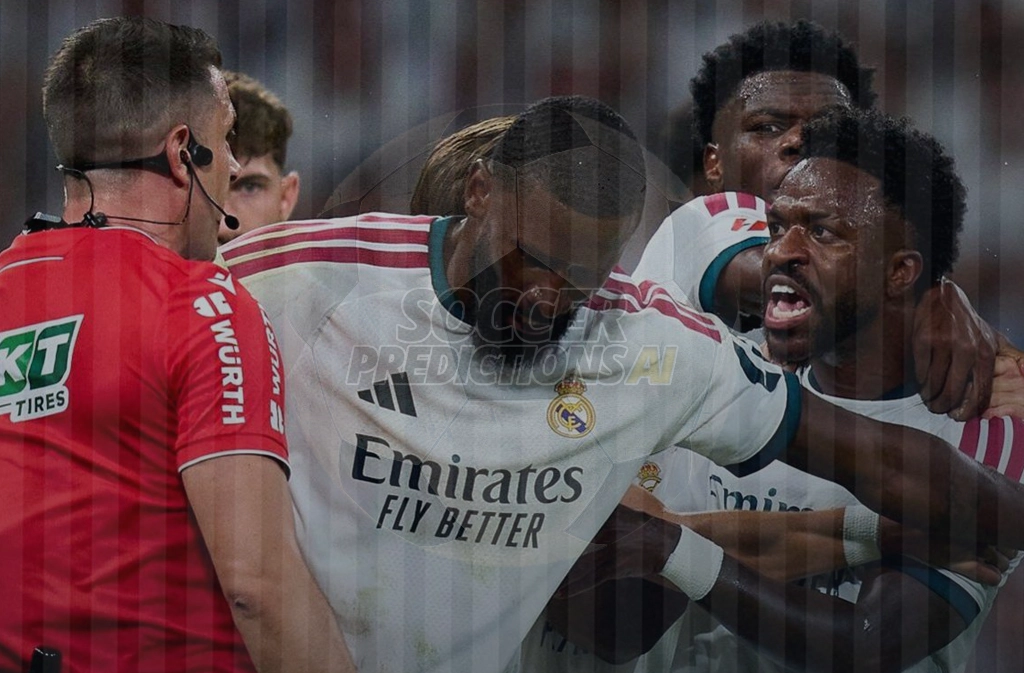
Vinicius Junior questions his four-match La Liga ban as Jose Mourinho criticises its timing before Real Madrid's dramatic 4-3 comeback against Roma.
Vinicius Junior and Mourinho furious over four-match suspension before Real Madrid comeback against Roma
Real Madrid's dramatic 4-3 Champions League victory over Roma has been overshadowed by a growing controversy surrounding the four-match suspension imposed on Vinícius Júnior just hours before kick-off. The Brazilian forward expressed his frustration with the timing of the decision and questioned the lack of communication from Spanish football authorities, while manager José Mourinho launched an extraordinary attack on the way the punishment was announced.
The disciplinary decision, issued by the Spanish Football Federation (RFEF) Competition Committee, became known shortly before Real Madrid arrived at the stadium for their second Champions League league-phase fixture. Instead of focusing exclusively on an important European encounter, Vinícius discovered that he would be unavailable for the next 4 La Liga matches, leaving him furious about both the punishment and the circumstances surrounding its announcement.
The controversy emerged on an evening that was already remarkable for sporting reasons. Real Madrid found themselves trailing Roma 3-1 before producing an extraordinary comeback to win 4-3, with substitutes playing a decisive role in transforming the contest. Endrick was particularly influential after his introduction, scoring a goal and helping change the attacking momentum of Mourinho's team.
Despite the victory, neither Vinícius nor Mourinho was prepared to ignore the disciplinary issue. Both questioned why the authorities had chosen to communicate such an important decision immediately before a Champions League match, arguing that the timing created an unnecessary distraction for a player preparing to represent a Spanish club in European competition.
For Mourinho, the situation appeared so extraordinary that he turned to a traditional Portuguese expression to illustrate his suspicions. The Real Madrid manager suggested that the manner in which the decision had been handled raised serious questions, although he did not present evidence establishing any deliberate attempt to interfere with his team's preparations.
Vinicius questions timing of four-match La Liga suspension
Speaking in the mixed zone after Real Madrid's victory in Rome, Vinícius made no attempt to hide his disappointment with the Spanish football authorities. The Brazilian international was particularly frustrated that he had received the news shortly before an important Champions League fixture, despite the authorities having had more time to communicate their decision.
"It was a bad moment. They had the entire day to announce the punishment, and it was only when I arrived at the stadium that I was told I would be suspended for four La Liga matches. I don't understand why," Vinícius explained.
The timing was central to his complaint. Professional footballers generally follow carefully structured routines before important matches, with attention focused on tactical instructions, physical preparation and the mental concentration required to compete at the highest level.
Learning about a substantial suspension just before kick-off can interrupt that preparation, particularly when the punishment affects several forthcoming domestic fixtures. Vinícius was required to process the consequences for his immediate future while simultaneously preparing for a demanding European encounter.
The forward did not question the importance of disciplinary regulations as a general principle. Instead, his comments focused on the way the decision was communicated and whether the authorities had properly explained the circumstances in which such a sanction could be imposed.
From the player's perspective, the announcement appeared unnecessarily disruptive. Real Madrid were preparing to face Roma in an important match, yet one of their most prominent attacking players arrived at the stadium to discover that he would be unavailable for a significant period of the domestic campaign.
The suspension does not directly concern the Champions League fixture itself, but its consequences for La Liga make it a major sporting issue. Missing 4 league matches could affect Vinícius's rhythm, his contributions to the team's attacking performances and Mourinho's plans for the coming weeks.
Those considerations help explain why the Brazilian reacted so strongly. He was not simply responding to a disciplinary announcement; he was confronting the prospect of losing several important opportunities to represent Real Madrid in domestic competition.
Brazilian forward claims new disciplinary rule was never explained
Vinícius also expressed confusion about the regulation behind his suspension, suggesting that the relevant rule had not been properly explained to Real Madrid's players.
"The rule is new, but nobody ever explained it to us. Someone from La Liga, or from the refereeing authorities, always comes to explain the rules and what has changed, but they never told us anything about this particular rule," he said.
His comments raise a separate issue from the timing of the announcement. While disciplinary regulations are intended to establish clear standards of conduct, players must also understand how those rules are interpreted and what consequences can follow particular actions.
Football authorities regularly communicate regulatory changes to clubs, particularly when adjustments affect refereeing decisions, disciplinary procedures or player behaviour during matches. Those explanations can help prevent confusion and ensure that teams prepare with an accurate understanding of the rules.
According to Vinícius, however, the regulation involved in his case had not been specifically explained. He believes that omission contributed to his surprise when the punishment was communicated.
The precise wording of the rule and the full reasoning behind the committee's decision were not included in the player's post-match comments. As a result, his statements should be understood as his account of the situation rather than independent confirmation that the authorities failed to fulfil a formal obligation.
Nevertheless, the controversy illustrates how disciplinary decisions can become more difficult to accept when players feel they have not received sufficient information about the rules being enforced.
For Real Madrid, the immediate concern is the impact of the suspension. For Vinícius, the issue also involves understanding why he received such a severe punishment and whether the same standards are being communicated consistently throughout Spanish football.
Vinicius insists he has never committed violence against another player
Beyond questioning the announcement and the regulation itself, Vinícius defended his conduct on the pitch. The Brazilian forward argued that his disciplinary record should be considered in the context of the treatment he receives from opposing players during matches.
"It's very easy to show me a red card, but I've never committed an act of violence against another player. I've always kept a cool head. I get fouled a lot, and yet I'm always the one who gets booked," he claimed.
The remarks reflect Vinícius's frustration with disciplinary decisions and the physical challenges he encounters during matches. As an attacking player who frequently attempts to beat defenders in individual situations, he can become involved in repeated confrontations with opponents trying to prevent him from progressing into dangerous areas.
Such encounters are a regular feature of elite football, particularly for players whose strengths include acceleration, dribbling and quick changes of direction. Defenders must attempt to limit their influence, while referees are responsible for determining whether challenges comply with the laws of the game.
Vinícius believes those situations have not always been handled fairly in his case. His comments suggest that he feels punished too readily, particularly when compared with the challenges he receives from opponents.
However, his claim that he has never acted violently is his own characterisation of his conduct. The specific disciplinary incident and the committee's legal reasoning would need to be examined before drawing conclusions about whether the four-match suspension was justified.
The Brazilian nevertheless made clear that he considers the decision excessive and difficult to understand. His frustration was intensified by the fact that the announcement arrived during preparations for a major European fixture.
Jose Mourinho launches strong criticism of Spanish football authorities
José Mourinho was equally unhappy with the circumstances surrounding the suspension. The Portuguese coach devoted part of his post-match comments to questioning why a disciplinary decision affecting one of his most important players had been announced so close to kick-off.
Mourinho argued that the authorities should have considered the sporting context, particularly because Real Madrid were preparing to represent Spanish football in the Champions League.
"Do you think it's normal for a player from a Spanish team, who is about to play a match that is also important for Spanish football, to find out just 2 hours beforehand that he has been handed a four-match suspension?" Mourinho asked.
"You don't need to answer. That's the question I'm asking. Couldn't they have announced it now, or tomorrow morning?" he continued.
The manager's comments focused on the distinction between imposing a punishment and selecting the moment when it becomes public. Mourinho did not argue that Real Madrid should be exempt from disciplinary decisions because they were competing in Europe. His criticism concerned whether announcing the sanction immediately before the game served any necessary purpose.
From his perspective, the situation created an avoidable distraction. Vinícius was preparing for a demanding encounter against Roma, and the news of his domestic suspension arrived at a moment when the player's concentration should have been directed towards the match.
Mourinho also described the circumstances in which the team discovered the decision.
"We were on the team bus, almost at the stadium, when we found out that Vinícius had been suspended for 4 matches," he explained.
Those details made the manager's dissatisfaction especially clear. He believed Real Madrid had been placed in an unnecessarily difficult situation immediately before an important European fixture, regardless of the eventual disciplinary outcome.
Mourinho uses Portuguese proverb to question the decision
The most memorable part of Mourinho's intervention came when he introduced a traditional Portuguese expression to describe what he believed was happening.
"In Portuguese, there's an expression that says 'gato escondido com o rabo de fora'," Mourinho explained.
The expression literally refers to a cat attempting to hide while leaving its tail visible. It is used when something supposedly concealed is actually obvious, particularly when someone's intentions or actions are not as well hidden as they might believe.
Mourinho then adapted the expression to suggest that, in his view, the situation had reached a stage where there was no longer even an attempt to conceal what was happening.
"It seems to me that the cat is no longer hiding. It seems it can now do whatever it wants. Things are being done shamelessly. The cat is no longer hidden," he declared.
The Portuguese coach has frequently used vivid language and rhetorical expressions when responding to controversial decisions throughout his career. On this occasion, the proverb allowed him to express his suspicions without identifying a specific individual as responsible for deliberately attempting to disrupt Real Madrid.
His words nevertheless carried a strong implication that he regarded the timing of the announcement as more than an unfortunate administrative decision.
Those suspicions remain Mourinho's interpretation of events. The information provided does not establish that the RFEF Competition Committee intentionally selected the timing to disadvantage Vinícius or Real Madrid.
Even so, the expression became the defining feature of Mourinho's reaction, turning an already controversial disciplinary announcement into another public confrontation between the manager and Spanish football authorities.
Real Madrid manager argues the decision damaged match preparations
Mourinho continued his criticism by emphasising the impact the announcement could have on a player's emotional preparation immediately before a Champions League match.
"Two hours before a match, a player has to find out that he's been suspended for 4 games. A Spanish team? A team that earned 3 points for Spanish football, for the rankings, for the prestige of Spanish football?" he questioned.
The manager was referring to the broader importance of Spanish clubs performing successfully in European competition. Victories in UEFA tournaments contribute to the results used in national association rankings, while strong performances can reinforce the international reputation of a domestic league.
In Mourinho's view, those circumstances made the timing particularly inappropriate. Real Madrid were preparing for an encounter that mattered not only to the club but also to Spanish football's competitive standing in Europe.
"Do you want to destroy a player's morale 2 hours before a match? That doesn't seem normal to me," he added.
His argument was based on the potential psychological disruption caused by the news. Learning about a substantial suspension can create immediate frustration, particularly when a player believes the punishment is unfair or has been poorly explained.
Managing that reaction becomes an additional responsibility for the coaching staff. Instead of concentrating exclusively on tactical instructions and opposition analysis, Mourinho and his colleagues had to contend with a situation involving one of their most prominent players.
However, the manager's comments did not suggest that the disciplinary decision was the sole explanation for Real Madrid's difficulties against Roma. The team ultimately recovered from a 3-1 deficit and secured a remarkable 4-3 victory, demonstrating that they were capable of responding despite the controversy.
Vinicius visibly frustrated after Mourinho substitutes him
The suspension was not the only subject Vinícius addressed after the match. The Brazilian also explained his reaction when Mourinho decided to substitute him during the encounter.
Vinícius left the pitch visibly unhappy, a reaction that attracted additional attention because Real Madrid were struggling to overcome Roma at the time.
However, the forward insisted that his frustration was a natural consequence of his desire to remain involved and help the team.
"It's normal to be upset after being substituted. I always want to play every minute. I want to be in good form so I can help the team, but today that wasn't possible," he explained.
The comments reflect the competitive mentality expected of attacking players operating at the highest level. Vinícius wants to remain on the pitch during important matches, particularly when his team are attempting to recover from a difficult position.
However, substitution decisions remain the responsibility of the manager. Mourinho must consider not only the ambitions of individual players but also the tactical requirements of the match and the options available on the bench.
Replacing an established attacker can be controversial, especially when that player possesses the ability to change a game through an individual moment of quality. Nevertheless, the effectiveness of Real Madrid's substitutions against Roma eventually provided a strong argument in favour of the manager's intervention.
Importantly, Vinícius did not attempt to undermine the decision after the final whistle. Despite acknowledging his disappointment, he praised the players who replaced members of the starting lineup and helped secure the comeback.
His comments suggested that his immediate emotional response to leaving the pitch did not prevent him from recognising the importance of the team's eventual victory.
Endrick praised for transforming Real Madrid comeback
Endrick received particularly strong praise from Vinícius after delivering an influential second-half performance against Roma.
Real Madrid had found themselves trailing 3-1, leaving Mourinho with the difficult task of changing the direction of a match that appeared to be moving towards defeat.
The introduction of fresh attacking options proved decisive. Endrick entered the encounter, brought additional energy to Real Madrid's forward movements and scored an important goal during the recovery.
Vinícius was enthusiastic about the young Brazilian's contribution.
"The substitutions helped us turn the game around. Endrick came on very well, changed the momentum of the match, scored a goal and was the best player in the second half," he said.
Those comments were particularly significant because they came from a player who had been visibly frustrated at being replaced. Rather than concentrating on his personal disappointment, Vinícius recognised that the changes had improved Real Madrid's performance.
For Endrick, the match represented an important opportunity to demonstrate his ability to influence major European fixtures. Young attackers competing at a club such as Real Madrid face enormous expectations and intense competition for playing time.
When opportunities arrive from the substitutes' bench, players often have limited time to establish themselves within the rhythm of the match. Making an immediate impact requires confidence, technical quality and the ability to make effective decisions under pressure.
Endrick's contribution against Roma demonstrated those qualities and strengthened his case for greater involvement in future matches.
Vinícius also expressed optimism about the younger player's development.
"We hope he continues to develop so he can help us," he added.
The statement highlighted the importance of maintaining strong relationships within the squad, particularly between established players and younger footballers attempting to earn additional opportunities.
Carlos Espi also recognised for valuable contributions
Vinícius extended his praise to Carlos Espí, another player who has received limited opportunities but has contributed when introduced from the bench.
"And another player, Carlos Espí, who always comes on for just a few minutes, has also been helping us a lot," the Brazilian forward said.
His comments reflected appreciation for players whose contributions may not always receive the same attention as those of established stars.
At a club with Real Madrid's ambitions, squad depth becomes particularly important during a demanding season. Managers need alternatives capable of influencing matches, whether through goals, creativity, additional energy or changes in tactical structure.
Players who receive only limited minutes can sometimes find it difficult to establish consistent form. They must remain prepared despite uncertain opportunities, while also adapting quickly when introduced into competitive situations.
Espí's contributions have clearly been noticed within the squad, with Vinícius acknowledging the value of his involvement.
The positive comments about Endrick and Espí also provided a contrast to the Brazilian's criticism of the disciplinary authorities. While he was clearly unhappy about his suspension and disappointed by his substitution, he remained willing to celebrate the contributions of his teammates.
That distinction was important after an evening containing several emotionally charged moments. Real Madrid had experienced a difficult start, faced a substantial deficit and eventually secured an extraordinary victory through the influence of players who began the match outside the starting lineup.
Real Madrid recover from 3-1 down to defeat Roma 4-3
The disciplinary controversy unfolded alongside one of the most dramatic results of Real Madrid's Champions League campaign.
Facing Roma away from home in the second round of the league phase, Mourinho's team struggled for significant periods and found themselves trailing 3-1.
The scoreline left Real Madrid facing a major challenge. A two-goal deficit against strong European opposition requires an effective attacking response while maintaining sufficient defensive organisation to avoid conceding again.
Mourinho turned to his substitutes in an attempt to change the contest, and the decisions eventually transformed the match.
Real Madrid recovered to score the goals required for a 4-3 victory, completing an extraordinary comeback that allowed the Spanish giants to collect 3 valuable points in the Champions League.
Endrick's contribution was particularly influential, with Vinícius identifying the young Brazilian as the outstanding player of the second half.
The result demonstrated Real Madrid's ability to recover from adversity, although the difficulties encountered before the comeback also raised questions about the team's original approach.
Conceding 3 goals and falling 2 behind is not the type of situation Mourinho would want his side to repeat frequently. Nevertheless, the comeback revealed the quality available within the squad and the capacity of substitutes to influence demanding fixtures.
The victory also strengthened the manager's argument that Real Madrid were representing Spanish football in an important European encounter when the disciplinary decision involving Vinícius was announced.
For Mourinho, securing the result did not make the timing of the suspension more acceptable. He continued criticising the circumstances after the match, despite having achieved the victory his team required.
Four-match absence creates another challenge for Mourinho
Beyond the immediate controversy, the suspension presents a practical problem for Real Madrid's domestic campaign.
Vinícius is one of the team's most recognisable attacking players, possessing the ability to create opportunities through his movement, technical skill and performances in individual situations.
Losing him for 4 La Liga matches will require Mourinho to consider alternative attacking combinations and determine how best to maintain the team's offensive threat.
That task becomes especially important during periods when domestic and European fixtures arrive close together. Coaches must manage squad rotation, fitness and tactical consistency, while also responding to unexpected absences caused by injuries or disciplinary decisions.
Real Madrid's comeback against Roma provided encouraging evidence that other attacking players can make important contributions. Endrick demonstrated his ability to change a match, while Espí received recognition from Vinícius for his recent involvement.
However, replacing a player across several full matches is different from introducing substitutes during the closing stages of an encounter.
Mourinho must identify a structure that allows the team to remain competitive without depending on the Brazilian's availability. That could involve adjusting responsibilities among established attackers or providing additional opportunities to players who have impressed from the bench.
The exact consequences for particular league fixtures will depend on the suspension's application and any subsequent developments in the disciplinary process. The statements provided do not confirm whether Real Madrid intend to challenge the punishment formally.
What is clear is that the manager must now prepare for a period in which an important attacking player is unavailable for domestic competition.
Disciplinary controversy raises questions about communication and transparency
The disagreement between Real Madrid and the Spanish football authorities involves 2 related but distinct issues: the substance of the four-match suspension and the timing of its announcement.
Vinícius questioned the regulation behind the punishment and argued that it had not been explained adequately. Mourinho concentrated more heavily on the decision to communicate the sanction just before an important Champions League match.
Both positions reflect frustration, but neither establishes that the disciplinary authorities acted improperly. Assessing the legitimacy of the suspension would require the relevant regulatory provisions, the committee's written reasoning and the circumstances of the incident that resulted in the punishment.
Similarly, determining whether the announcement was deliberately timed to interfere with Real Madrid's preparations would require evidence beyond the suspicions expressed by Mourinho.
Nevertheless, the episode demonstrates why clear communication can be important in disciplinary matters. Clubs and players need to understand the regulations governing their conduct, the reasons behind significant sanctions and the procedures through which decisions are communicated.
When an important announcement arrives unexpectedly, particularly shortly before a major fixture, the lack of explanation can become a controversy in its own right.
That is precisely what happened in Rome. Instead of discussing only Real Madrid's remarkable comeback, attention turned towards the RFEF Competition Committee, the timing of its decision and the angry responses delivered by one of the club's leading players and its manager.
Mourinho's use of the Portuguese proverb ensured that the issue would receive even greater attention, while Vinícius's comments added a personal perspective on the impact of the announcement.
Mourinho and Vinicius united in criticism after dramatic European night
Although Vinícius and Mourinho approached the subject differently, their comments revealed a shared belief that the suspension had been communicated at an inappropriate moment.
The Brazilian was primarily concerned with the lack of explanation surrounding the rule and the frustration of discovering his punishment upon arriving at the stadium.
The Portuguese manager was particularly critical of the wider circumstances, questioning why a player preparing to represent Spanish football in Europe had been informed of such a significant decision only 2 hours before kick-off.
Both expressed their dissatisfaction after Real Madrid had already secured a memorable victory over Roma, showing that the final result had not reduced their concern about the disciplinary process.
The situation also created a striking contrast between Vinícius's personal frustration and the collective achievement of the team.
Despite receiving disappointing news before the match and reacting angrily when substituted, the Brazilian praised Endrick and Carlos Espí for their contributions to the comeback.
His willingness to recognise the importance of the substitutions showed that he could separate his individual disappointment from the success of his teammates.
For Mourinho, the victory provided another example of Real Madrid's ability to recover from difficult situations, but it also left him facing the prospect of reorganising the team for several forthcoming league matches.
The coach must now manage the sporting consequences of Vinícius's absence while ensuring that the controversy does not become a continuing distraction.
Real Madrid victory cannot erase questions surrounding Vinicius suspension
Real Madrid's 4-3 victory over Roma will be remembered as an extraordinary Champions League comeback, but the events surrounding Vinícius Júnior's suspension have added another dimension to the encounter.
The Brazilian forward arrived at the stadium to discover that he had received a four-match La Liga ban, leaving him frustrated by the timing of the announcement and confused about the regulation involved.
He questioned the disciplinary process, defended his conduct on the pitch and argued that players should receive clearer explanations when important rules are introduced or changed.
Mourinho was equally outspoken, using the Portuguese expression about a supposedly hidden cat whose tail remains visible to suggest that the circumstances surrounding the decision were suspicious.
His comments represented a forceful criticism of the timing, although the suggestion of deliberate interference remains an allegation rather than an established fact.
On the pitch, Real Madrid demonstrated exceptional resilience by recovering from 3-1 down to win 4-3, with Endrick emerging as a decisive figure after coming off the bench.
Vinícius acknowledged the young Brazilian's contribution and also praised Carlos Espí, despite admitting that he had been unhappy about being substituted.
Those positive moments offered encouragement for Mourinho, particularly as he prepares for a period without Vinícius in domestic competition.
However, the wider controversy remains unresolved. The Brazilian believes the punishment and its communication require explanation, while Mourinho considers the decision to announce it immediately before a Champions League match unacceptable.
For Real Madrid, the immediate sporting objective is to maintain the momentum created by the dramatic victory in Rome. The club must also manage the consequences of the suspension and ensure that the team remains competitive throughout the coming domestic fixtures.
The episode illustrates how quickly a major European victory can become overshadowed by events away from the pitch. Real Madrid secured 3 important Champions League points, but the conversation after the final whistle was dominated by a disciplinary decision announced only hours before the game.
With Vinícius facing 4 matches on the sidelines in La Liga and Mourinho publicly questioning Spanish football authorities, the controversy is likely to remain a prominent subject of discussion. For now, Real Madrid can celebrate an unforgettable comeback while preparing for the challenges created by the absence of one of their most important attacking players.