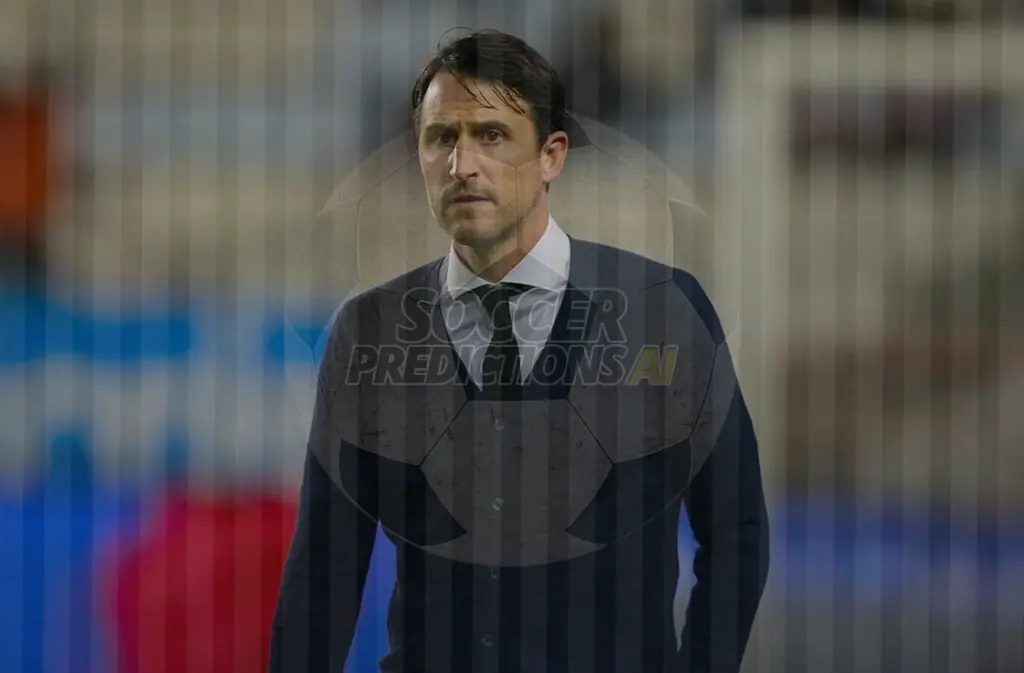
Beñat San José is the new Rayo Vallecano coach after Iñigo Pérez left for Villarreal following the clubs historic European campaign.
Beñat San José appointed as new Rayo Vallecano coach after historic European campaign
Rayo Vallecano have officially confirmed Beñat San José as their new head coach, opening a fresh chapter for the Madrid-based club after one of the most memorable periods in its recent history. The Spanish coach arrives to replace Iñigo Pérez, who has left Vallecas to take charge of Villarreal after guiding Rayo to the first European final in the club history.
The appointment marks an important moment for Rayo. The club is not simply replacing a coach; it is trying to protect the competitive identity built in recent seasons while also preparing for a new tactical cycle. After the emotional highs of reaching the Conference League final, where Rayo were narrowly beaten 1-0 by Crystal Palace, the next manager faces the difficult task of keeping the team ambitious, organised and mentally ready for another demanding campaign.
San José, born in San Sebastián, arrives with a broad and unusual coaching background. At 46 years old, he has already worked across several football cultures, from Spain to Saudi Arabia, Chile, Bolivia, the United Arab Emirates, Belgium and Mexico. That international experience is one of the defining features of his career and gives Rayo a coach used to adapting quickly to different dressing rooms, competitive environments and tactical realities.
His most recent work came at Eibar, where he had been in charge since February 2025. Although the Basque club finished eighth in the Spanish second tier and narrowly missed out on the promotion play-off places, San José left a strong impression during his short spell. Under his command, Eibar produced the best second half of a season in the club history, collecting 43 points from a possible 64. That run showed his ability to transform momentum, organise a squad quickly and create belief in a team during a crucial phase of the season.
That quality will be particularly important at Rayo Vallecano. The Madrid club have built much of their modern identity around intensity, collective effort and emotional connection with their supporters. Vallecas is not an easy place for opponents, and the fans expect a team that competes with energy, courage and personality. San José will know that results matter, but the way Rayo play also matters deeply to the people who follow the club every week.
The departure of Iñigo Pérez leaves a significant gap. Pérez did not only deliver results; he helped give Rayo one of the proudest moments in their history by leading the team to a European final. Reaching the Conference League final was already a remarkable achievement for a club of Rayo size and resources, even if the final itself ended in disappointment against Crystal Palace. The 1-0 defeat will hurt, but the journey to that stage changed the perception of what this team can aspire to.
For that reason, San José enters a job full of opportunity but also pressure. Rayo are not starting from zero. They have a squad accustomed to competing above expectation and a fan base that has recently experienced a historic European adventure. The challenge now is to avoid a drop in intensity after that high point. Many clubs struggle after a major achievement because expectations rise, opponents show more respect and the emotional energy of the previous campaign becomes difficult to repeat.
San José will be expected to bring stability to that transition. His career suggests he is a coach comfortable with complex situations. He began in the youth ranks of Real Sociedad, a club known for technical development and structured football education. That early experience gave him a foundation in player improvement, tactical organisation and long-term coaching work. From there, his career quickly became international, taking him to Saudi Arabia and opening a path that would make him one of the more travelled Spanish coaches of his generation.
In Saudi Arabia, he worked with Al-Ittihad under-21s before stepping into the senior team. That period brought early success, including the King Cup in 2013. Winning silverware so early in a senior coaching career is never insignificant. It gave San José practical experience of pressure, finals and dressing-room management, elements that often shape a coach far more than theory alone.
His career then expanded across different continents. He coached Al-Ettifaq in Saudi Arabia, Deportes Antofagasta and Universidad Católica in Chile, Bolívar in Bolivia, Al-Nasr in the United Arab Emirates, KAS Eupen in Belgium, and Mexican sides Mazatlán and Atlas. Each of those stops added a different layer to his coaching profile. South American football brought intensity, passion and tactical flexibility. Belgian football offered a European environment with a strong developmental focus. Mexico brought another demanding league with its own rhythm, media pressure and competitive unpredictability.
Some of his strongest achievements came in South America. With Bolívar, he won both the Apertura and Clausura tournaments in 2017, completing a dominant year in Bolivian football. He later added another Bolivian championship in 2023, further strengthening his reputation in the country. At Universidad Católica, he won the Chilean championship in 2018, another important title in a competitive league where tactical detail and consistency across the season are essential.
Those trophies show that San José is not arriving at Rayo as an unknown experiment. He has won league titles, managed clubs with expectations and taken teams through demanding competitions. In 2023, he also guided Bolívar to the quarter-finals of the Copa Libertadores, a run that demonstrated his ability to compete on a continental stage. For a club like Rayo, which has just experienced European football at a historic level, that background is valuable.
His spell at KAS Eupen in Belgium also deserves attention. In the 2020/21 season, he led the club to the semi-finals of the Belgian Cup, a strong achievement for a team not usually considered one of the main powers in Belgian football. That kind of run matters because Rayo often operate in a similar emotional space: a club that may not have the financial weight of the biggest teams, but can cause serious problems when structure, belief and tactical discipline come together.
At Rayo, the immediate question will be how San José wants his side to play. The squad has been used to a high-energy style, with aggressive pressing, quick transitions and strong emotional involvement. A drastic departure from that identity would be risky. However, every coach brings his own details, and San José will likely try to add control, positional structure and better management of match phases without taking away the intensity that defines the club.
One of the major tasks will be maintaining defensive balance. Rayo have often been at their best when the team defends as a unit, presses with coordination and prevents opponents from playing comfortably through midfield. San José has shown in different countries that he can organise teams to compete with discipline, but La Liga brings very specific challenges. Spanish football punishes poor spacing, slow reactions and emotional lapses. Against technically strong opponents, Rayo will need to be aggressive without becoming exposed.
Another important area will be the attack. Rayo supporters will want to see a team that plays with courage at Vallecas, not one that simply protects itself and waits. San José must find ways to make the side dangerous without relying only on emotional momentum. The best Rayo teams combine intensity with surprise: wide attacks, quick combinations, pressing recoveries and brave movement from midfield. The new coach will need to give the team enough attacking mechanisms to compete consistently across a long season.
The move also represents a personal return to Spanish football at a higher level for San José. After his work at Eibar, this appointment gives him the chance to establish himself in La Liga with a club that has visibility, identity and recent momentum. For many coaches, Rayo is not an easy job, but it is a meaningful one. Success at Vallecas is noticed because it usually comes with limited resources and strong tactical work.
Replacing Iñigo Pérez after such a historic campaign will not be simple. There will naturally be comparisons, especially during difficult periods. If results do not arrive quickly, the memory of the Conference League run will become a shadow over the new project. But that is also part of the opportunity. San José is not arriving at a broken club. He is arriving at a team with belief, recent European experience and proof that it can go beyond expectations.
For Rayo management, the choice of San José suggests a desire to combine ambition with coaching experience. This is not a glamorous appointment built only around a famous name. It is a decision based on a coach who has worked in difficult markets, won titles, handled different football cultures and recently improved Eibar in a very visible way. That profile may fit Rayo better than a coach who arrives with more media noise but less adaptability.
The coming weeks will be decisive. San José will need to meet the squad, evaluate which players fit his ideas and identify the areas where the team needs reinforcement. Pre-season will be crucial, especially because Rayo are coming out of a campaign with a major emotional and physical load. Managing fatigue, motivation and expectations will be just as important as tactical training.
There will also be a need to reconnect the team with the supporters under a new voice. Vallecas is one of the most distinctive environments in Spanish football, and the relationship between coach, players and fans can influence the season. If San José can convince supporters early that his team will remain brave, competitive and faithful to the club spirit, he will have a stronger platform to build from.
For the players, the appointment creates a fresh dynamic. Some will see it as an opportunity to win a bigger role. Others will need to adapt to new demands. A change of coach always resets internal competition, and San José will likely use that to increase intensity in training. After a historic European final, complacency is one of the dangers. A new manager can help prevent that by making every player prove himself again.
The broader context also matters. La Liga remains highly competitive, and clubs outside the elite must be efficient in almost every area to survive and grow. Rayo cannot rely only on inspiration. They need coaching detail, smart recruitment, physical consistency and emotional resilience. San José has enough experience to understand that a club like Rayo must maximise every advantage, from home atmosphere to tactical preparation.
His past success in Bolivia and Chile shows he knows how to win. His experience in Belgium and Mexico shows he can adapt. His recent work at Eibar shows he can improve a team quickly inside Spanish football. Now the challenge is to bring all those elements together in Vallecas, where patience can be limited but support can be powerful when the team reflects the identity of the club.
Rayo Vallecano are entering a new phase after a season that will be remembered for years. The Conference League final may have ended in defeat, but it changed the emotional ceiling of the club. Beñat San José now inherits that legacy and must turn it into a sustainable project. The task is difficult, but the opportunity is significant.
For San José, this is perhaps the most important appointment of his career in Spain. For Rayo, it is a chance to prove that the success of recent years was not an isolated moment. The club has chosen a coach with titles, international experience and a recent record of strong improvement at Eibar. Now the real work begins: keeping Rayo competitive, ambitious and true to the spirit of Vallecas.